


A green L-shaped sofa is one of the most versatile statement pieces you can add to a living room. The color reads as warm or cool depending on the surrounding palette, works across Scandinavian, maximalist, and contemporary styles, and tends to make a room feel more alive than the beige or grey alternatives most buyers default to. This guide covers every decision: shade selection, room placement, styling combinations, and what to pair it with to get the look right the first time.
Choosing the Right Shade of Green
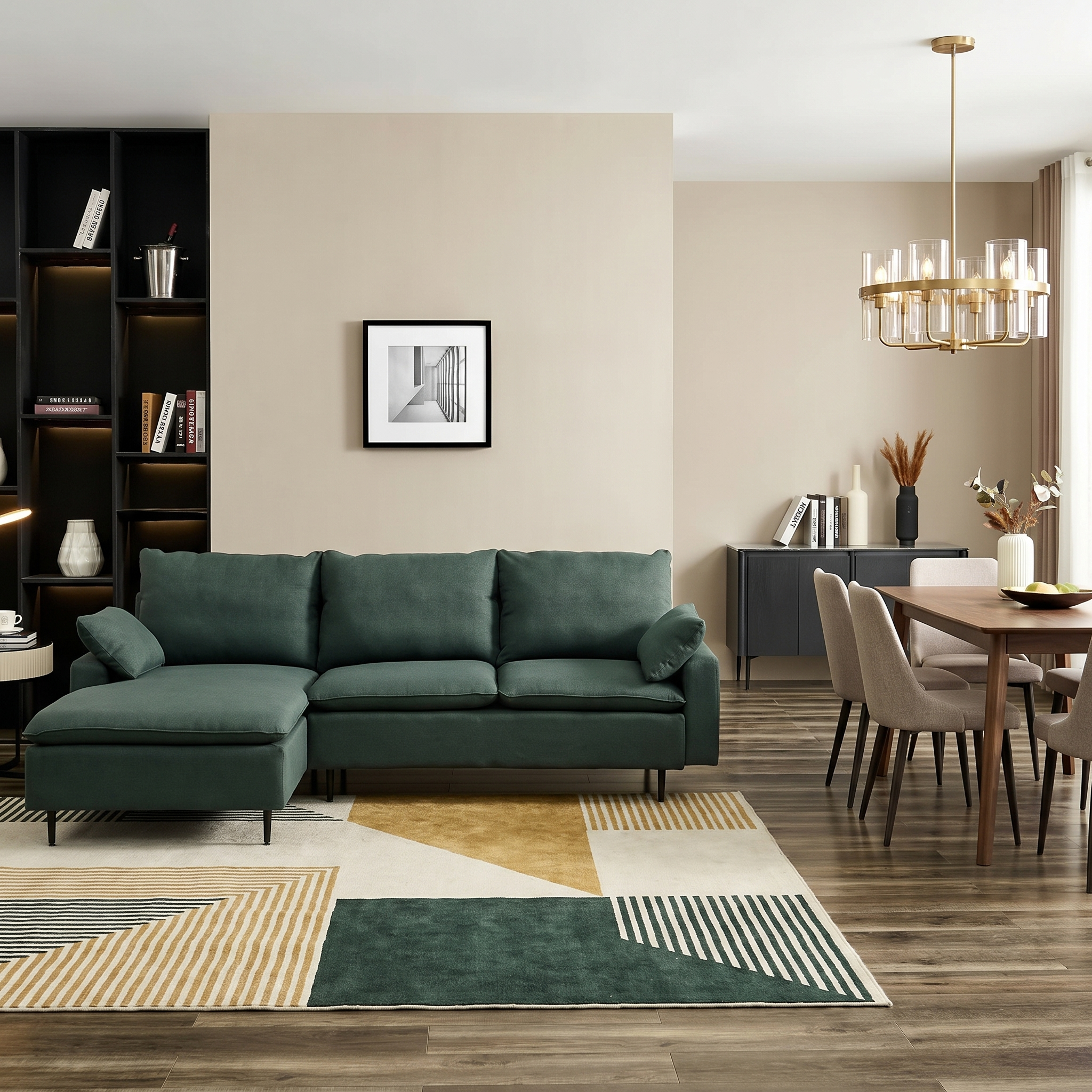
Green sofas span an enormous range — from barely-there sage to deep forest to jewel-tone emerald. Each reads differently in a room, and picking the wrong shade is the most common mistake buyers make without seeing the piece in context.
Forest green and deep green: The richest option. Works in rooms with natural light and pairs exceptionally well with warm wood tones, brass or gold hardware, and terracotta. The Luxe Forest Green L-Shaped Sofa hits this depth without being overpowering — the velvet texture adds light variation that keeps it from feeling flat or heavy.
Sage and muted olive: Easier to style, works in rooms with less natural light. More neutral in feel — can almost read as a non-colour depending on the light. Good choice if you want green without committing to it as the dominant focal point.
Emerald and jewel tones: High contrast, maximalist. Best in larger rooms or in homes with a more eclectic aesthetic. Harder to pivot later if the style of the room shifts.
L-Shaped vs. Standard Sofa: When the L-Section Wins
The L-shape is the right choice in three scenarios:
- You have an open-plan layout: The L helps define the living zone without walls. The longer arm anchors the seating area visually.
- You have four or more regular users: An L-shaped sofa comfortably seats 5–7 people, versus 3–4 on a standard three-seater.
- You want to double the sofa as casual sleeping: The chaise extension creates a comfortable lounging length for one person without needing a separate daybed.
The trade-off is room footprint. Measure carefully before ordering — an L-shaped sofa typically requires at least 100 sq ft of floor area to not feel cramped, and traffic flow around the long arm needs clearance of at least 30 inches.
Room Placement: How to Position an L-Shaped Sofa
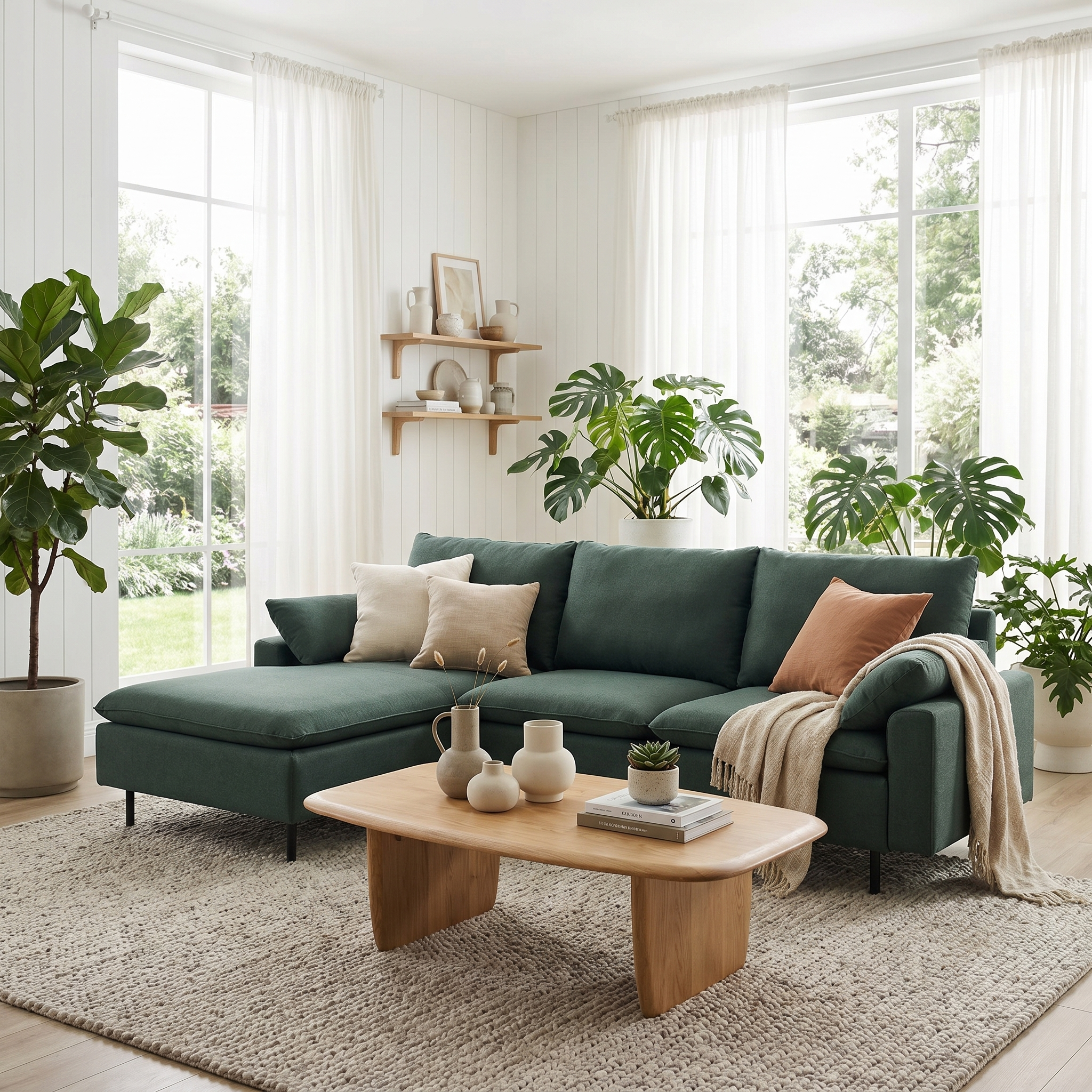
The most common placement mistake is pushing all furniture against the walls. L-shaped sofas look better and feel more usable when floated — with the back facing the room's focal point (fireplace, TV wall, windows) and with the chaise arm pointing toward a corner or wall rather than into the traffic path.
In open-plan spaces: Use the sofa's back as a room divider. Position it so the sofa back faces the kitchen/dining area and the seating faces the living zone. Add a console table or shelving behind the sofa to define the boundary and add storage.
In dedicated living rooms: Float the sofa a foot or two from the back wall if space permits. This makes the room feel more intentional and allows lamp placement behind the sofa without crowding.
Traffic flow: The L's corner should point toward a less-trafficked area. The end of the chaise section should never block a doorway or the main path through the room.
What to Pair with a Green Velvet Sofa
Green velvet is easy to style because it reads warm (from the velvet's light-catching quality) even in cooler tones. The following combinations consistently work:
Warm Neutrals + Natural Wood
Cream, off-white, and warm grey walls let the green take center stage. Natural oak or walnut furniture in the same room avoids competition — the warmth of wood pulls out the warm undertones in the green velvet. Brass and gold hardware (lamp bases, coffee table legs) elevate the palette further.
Earth Tones and Terracotta
Terracotta cushions, rust-toned ceramics, and terracotta-tinted rugs are one of the most cohesive pairings for deep forest green. The warm orange tones are complementary on the color wheel and read sophisticated rather than matchy.
Black and White Accents
For a contemporary edge, pair the green velvet with graphic black-and-white elements: striped cushions, a black metal coffee table, black-framed artwork. This creates higher contrast without adding more color.
Plants and Greenery
Adding plants in the same room as a green sofa is not redundant — it's grounding. The natural green of plants and the saturated green of velvet read as different enough that they complement rather than clash. Large-leaf plants (fiddle leaf fig, monstera) work especially well next to the scale of an L-shaped sofa.
Rugs: The Anchor That Makes Everything Work
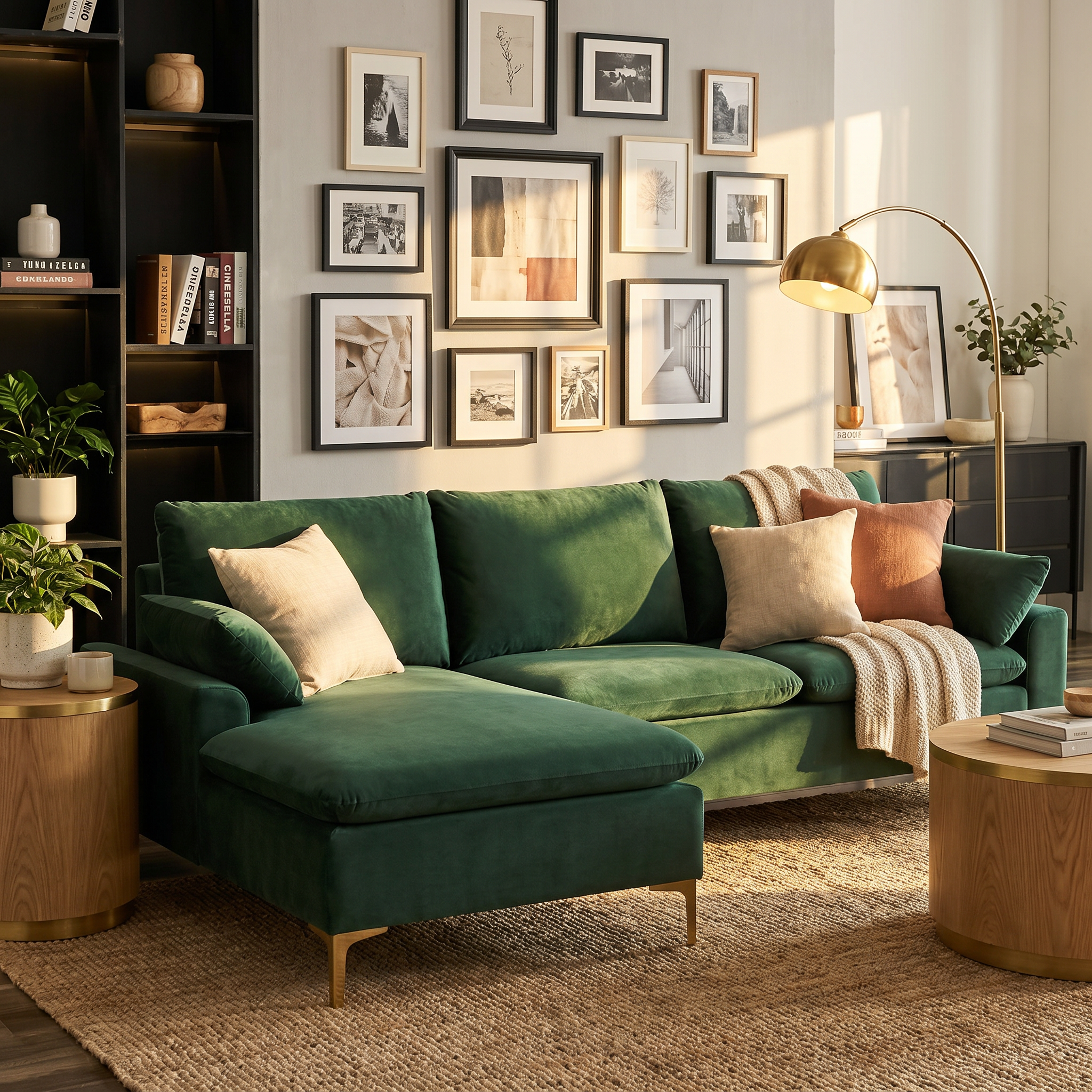
A rug is non-negotiable with an L-shaped sofa. Without one, the sofa floats visually in the room. With one, it becomes a cohesive conversation zone.
For a forest green sofa: cream or off-white rugs, warm beige rugs, natural jute, or dark charcoal. Avoid cold grey or blue-toned rugs which conflict with the warmth of the velvet. Size the rug so both the sofa front legs and the coffee table are on it — typically a 9×12 ft or 8×10 ft rug for a standard L-shaped configuration.
Lighting That Works with Green Velvet
Green velvet absorbs light rather than reflecting it, which makes the sofa look deeper in color in dim conditions and lighter in bright, warm light. Use warm ambient lighting to bring out the richness of the fabric. A floor lamp with a warm-toned shade positioned near the chaise end creates a reading corner and adds point-source light that makes the velvet glow.
For the space above the sofa: a wall-mounted plant lamp or a sconce at head height on the wall behind the sofa adds architectural interest without cluttering the surface.
Maintenance: Velvet Is Easier Than It Looks
Velvet has a reputation for being high-maintenance that it doesn't quite deserve. Modern performance velvets (microvelvet, velvet-blend fabrics) are considerably more durable than traditional silk velvet.
Daily maintenance: brush with a soft velvet brush in the direction of the pile to prevent flattening. For spills: blot immediately with a clean cloth — never rub, which spreads the stain and damages the pile. For deeper cleaning, use a diluted fabric cleaner and a soft brush. Test on an inconspicuous area first.
Flattened velvet from regular use can often be restored by holding the fabric over steam and brushing gently in the pile direction — a garment steamer works well for this.
FAQ: Styling a Green L-Shaped Sofa
What colors work best with a green velvet sofa?
Warm neutrals (cream, off-white, warm grey) and natural wood tones work best. Terracotta and rust accents are a particularly strong pairing. For a bolder look, dark charcoal or near-black walls make the green velvet pop dramatically. Avoid cool blues and cold greys, which conflict with the warmth of most green velvet shades.
How do I clean a velvet sofa?
For daily care, brush the velvet in the pile direction with a soft brush to prevent flattening. Blot spills immediately — never rub. For spot cleaning, use a diluted fabric cleaner applied with a soft cloth. Many modern velvet sofas have removable cushion covers that are machine washable — check the care tag on your specific piece.
What size room do I need for an L-shaped sofa?
An L-shaped sofa works best in rooms at least 12×12 ft. In smaller spaces, it can work if the room is well-organized and furniture is minimal, but traffic flow around the long arm needs at least 30 inches of clearance. Open-plan layouts can accommodate larger L-shapes since the sofa becomes a room divider rather than a room-filler.
What rug size should I pair with an L-shaped sofa?
For most L-shaped sofas, a 9×12 ft rug is ideal. The goal is to have the front legs of both sofa arms sitting on the rug. In smaller rooms, an 8×10 ft rug works if space is tight. A too-small rug (like a 5×8) will make the sofa look disconnected from the rest of the room.
Should I place the sofa against the wall or float it?
For open-plan spaces, floating the sofa creates better room definition and is usually the better look. For smaller dedicated living rooms, pushing the sofa back a foot from the wall is a good compromise — it creates visual breathing room without sacrificing too much floor space.
Is velvet durable enough for everyday use?
Modern performance velvet is significantly more durable than traditional silk velvet. Most contemporary velvet sofas use microvelvet or velvet blends rated for regular residential use. The main wear pattern to watch is pile flattening in high-contact areas, which can be managed with regular brushing and occasional steaming.

