


Gold Chandeliers: How to Choose the Perfect One for Your Home
A gold chandelier transforms any room from ordinary to refined. Whether you are drawn to warm brass tones or polished champagne finishes, the right gold chandelier creates warmth, drama, and a focal point that anchors your entire interior. The key is matching gold tone, size, and fixture style to your specific room — get those three variables right and the result feels inevitable rather than decorative.

What Makes a Gold Chandelier the Right Choice?
Gold lighting occupies a unique position in interior design: it reads as both contemporary and timeless simultaneously. Unlike chrome or brushed nickel, which recede visually, gold advances — it catches and warms ambient light, adding depth to a room's palette.
The practical case for gold is equally strong. Gold finishes are highly versatile across design styles. Warm antique gold anchors traditional and transitional interiors. Satin brass reads cleanly in modern farmhouse and Japandi rooms. Polished gold brings dramatic luxury to maximalist and Hollywood Regency aesthetics. Matte gold works in contemporary minimal spaces without the glare of a polished finish.
Gold chandeliers also photograph beautifully, which matters for dining rooms and primary bedrooms that appear in social media and home tours. The finish holds its visual weight even in ambient or candlelit photography — unlike chrome, which can flatten in warm light.
How to Size a Gold Chandelier
Correct sizing is non-negotiable. An undersized chandelier reads as timid; an oversized one overwhelms the room. The industry formula is reliable: add the room's length and width in feet, then convert that sum to inches for the ideal fixture diameter.
A 12 × 14-foot dining room — length plus width equals 26 — calls for a chandelier roughly 24–28 inches in diameter. For foyers and entryways with double-height ceilings, use half the foyer's width as your target diameter.
| Room | Recommended Diameter | Hanging Height |
|---|---|---|
| Dining Room (10×12 ft) | 22–26 inches | 30–34 inches above table |
| Dining Room (12×14 ft) | 26–30 inches | 30–34 inches above table |
| Living Room (14×16 ft) | 28–34 inches | 7 feet above floor |
| Entryway / Foyer (standard ceiling) | Half the foyer width | 7 feet above floor |
| Double-height Foyer | One-third ceiling height in width | Bottom at 7 ft from floor |
| Bedroom (12×12 ft) | 20–24 inches | 7 feet above floor |
| Bedroom (14×14 ft) | 22–26 inches | 7 feet above floor |
For rooms with 9-foot ceilings, leave at least 7 feet of clearance from the bottom of the fixture to the floor. Add 3 additional inches of hanging height for every foot above 8 feet of ceiling height.
Warm Gold vs. Cool Gold: Matching Tone to Your Interior
Not all gold finishes are equal. The temperature of your gold finish has a significant impact on how it reads in a room — particularly against wall colors, furniture, and natural light.
Warm gold (including antique brass, aged bronze-gold, and traditional polished gold) registers with yellow-orange undertones. It pairs beautifully with warm wood tones, cream walls, terracotta, warm greys, and earthy palettes. Warm gold dominates traditional, transitional, and French country interiors. It is the default choice for spaces with oak flooring, linen upholstery, and warm-toned neutrals.
Cool gold (champagne gold, pale satin brass, and muted champagne finishes) leans toward yellow-beige with minimal orange. It integrates cleanly with cool-toned rooms: grey floors, white oak cabinetry, marble countertops, and blue or green palettes. Champagne gold is the go-to finish for Scandinavian-influenced and modern transitional interiors where the goal is sophisticated warmth without heaviness.
When in doubt: if your room has warm wood tones, choose warm gold. If your room is predominantly white, grey, or marble, choose cool champagne gold.
Gold with Different Wall Colors
Wall color determines how dramatically a gold chandelier reads. Understanding this relationship helps you get maximum visual impact.
White walls create clean, high-contrast staging for gold fixtures. The chandelier becomes the clear focal point. This works especially well with crystal or glass droplet styles, where the sparkle pops against a neutral background.
Dark walls — deep navy, charcoal, forest green, or black — intensify gold's reflective warmth. The contrast is dramatic and sophisticated. Dark-wall rooms with gold chandeliers read as deeply luxurious, particularly in dining rooms and bars. The Aurelius – Golden Orbit LED Chandelier performs particularly well against dark moody walls, where its circular form creates a bold statement.
Greige and warm grey walls create tonal harmony with warm gold. The effect is refined rather than dramatic — correct for spaces where you want the room to feel pulled together without one element dominating.
Warm terracotta, sage green, and dusty rose walls each pair distinctively with gold. Terracotta amplifies gold's warmth into an earthy, Mediterranean palette. Sage creates a natural, botanical feel. Dusty rose combined with gold reads as quietly glamorous, somewhere between Art Deco and contemporary.
Crystal, Glass, or Metal: Matching Style to Room
The material of the chandelier body changes its light quality and visual weight — both important considerations beyond just the gold finish.
| Material/Style | Best Room | Light Quality | Interior Style | Starting Price |
|---|---|---|---|---|
| Crystal (K9 glass) | Dining room, entryway | Prismatic, dramatic | Traditional, glam, Hollywood Regency | From $100 |
| Glass droplet / orb | Dining room, living room | Soft, diffused | Modern, organic, Japandi | From $150 |
| Cascading waterfall | Double-height foyer, living room | Layered, ambient | Contemporary, maximalist | From $265 |
| All-metal geometric | Kitchen, living room | Direct, architectural | Modern, minimalist, industrial | From $140 |
| LED ring / halo | Any room with 9+ ft ceilings | Even, dimmable | Contemporary, Scandinavian | From $195 |
For dining rooms, crystal and glass droplet styles are the strongest performers — they catch the light beautifully over a meal and create ambient sparkle. The Crystal Rain – Comet Cascade Chandelier at $100 is an accessible entry point into gold crystal dining room lighting, with cascading droplets that create prismatic light without the weight of full K9 crystal.
For living rooms, cascading and waterfall styles earn their scale. The Gold Crystal Circle – Modern LED Chandelier at $288 brings contemporary geometry to living spaces — its circular form is balanced and architectural without competing with the room's furniture.
Room-by-Room Guide: Where to Use a Gold Chandelier
Dining room — the natural home for a gold chandelier. Center the fixture precisely over the table, not the room. Hang 30–34 inches above the tabletop. Choose crystal or glass droplet styles for maximum sparkle over meals. Always wire to a dimmer.
Living room — scale generously. Undersized chandeliers look tentative above large seating groups. A living room chandelier should command the central zone. Cascading or waterfall forms work particularly well here because their visual complexity matches the furniture mix of a lived-in living space.
Entryway and foyer — the first impression. For double-height foyers, cascading crystal styles are traditional but justified by the visual drama they create. For standard-ceiling entryways, a more refined ring or orb style keeps proportion correct. The Aether – Infinity Gold LED Chandelier at $574 is specifically designed for grand foyer and staircase applications, with multi-ring construction that fills vertical space.
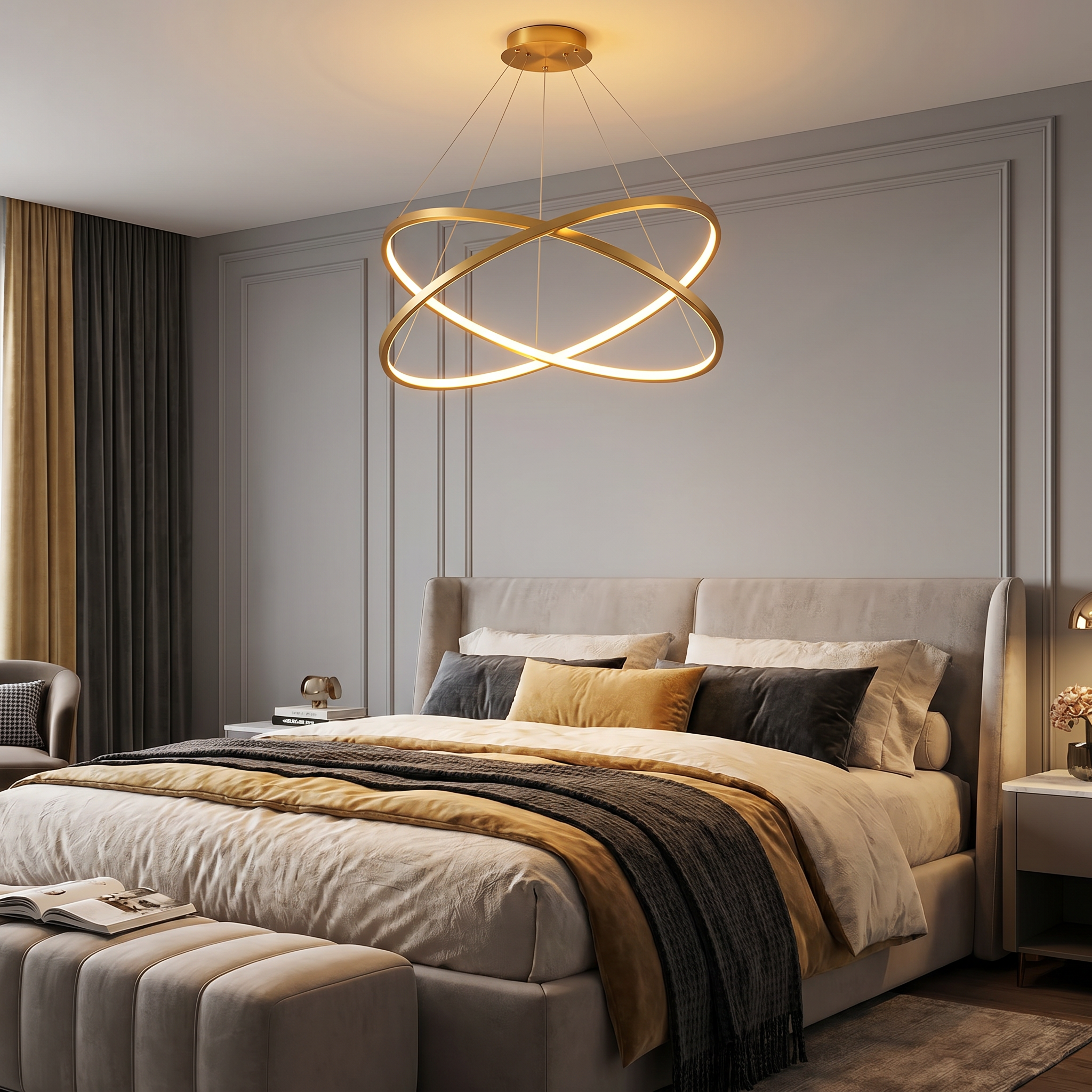
Bedroom — keep scale modest compared to the ceiling height, and always use a dimmer. Bedrooms benefit from chandeliers that diffuse light softly rather than projecting it directly. The Lyra – Gold Butterfly LED Chandelier at $106 delivers a delicate, feminine silhouette in gold and crystal — appropriately sized for most primary and guest bedrooms.
Powder room — an underused opportunity. A small gold chandelier in a powder room creates a disproportionate impression of luxury. Scale to the small space (12–16 inch diameter maximum), hang so the bottom clears the door and mirror, and choose a style with sparkle — the small scale rewards detail work.

Installation Considerations
Before purchasing, verify your ceiling box is rated for the weight of your chosen fixture. Most residential junction boxes hold 35–50 pounds; canopy kits or fan-rated boxes extend this to 150 pounds for heavy crystal installations.
Hanging height adjustments are easier if you plan for them at installation. Suspension chains or cables allow height fine-tuning without rewiring. For dining rooms, a chandelier that can be raised 2–3 additional inches accommodates large centerpieces and holiday decorations without looking cramped.
Gold finishes vary in maintenance requirements. Polished gold shows fingerprints more readily than brushed or satin finishes. For pieces with multiple crystal elements, budget time every 6–12 months for dusting and occasional deep cleaning. The warmth of gold is worth it — but set expectations before committing to a high-maintenance finish in a high-traffic area.
Dimmer Compatibility and Bulb Choice
Gold chandeliers should always be wired to a compatible dimmer switch. The warmth and drama of gold lighting is maximized at 60–80% brightness for dining and entertaining; full brightness works for task-heavy contexts.
Bulb color temperature has a direct effect on how your gold finish reads. Warm white (2700K–3000K) amplifies gold's natural warmth and creates the intimate glow that makes gold chandeliers so effective. Cool white (4000K+) neutralizes the finish and can make gold look greenish — avoid it for decorative chandeliers in living spaces.
LED candelabra bulbs (E12 base) have replaced incandescent in most modern chandeliers. Look for bulbs rated 2700K–3000K and confirm your dimmer is LED-compatible to avoid flickering.
Frequently Asked Questions
What size gold chandelier do I need for a dining room?
For a standard dining room (10×12 to 12×14 feet), choose a chandelier 22–30 inches in diameter and hang it 30–34 inches above the table surface. Add room length plus width in feet to get the target diameter in inches: a 12×14 room calls for 26 inches. Always center the fixture over the table, not the room center.
Can a gold chandelier work in a modern or contemporary interior?
Yes — choose geometric, ring, or LED halo styles in satin or matte gold rather than highly ornate crystal designs. Modern interiors handle gold best when the fixture has a clean, architectural silhouette. A brushed or champagne gold finish reads contemporary; heavy K9 crystal reads traditional. The two aesthetics overlap in transitional spaces where both are appropriate.
What is the difference between warm gold and champagne gold?
Warm gold has orange-yellow undertones and pairs with wood tones, cream walls, and earthy palettes. Champagne gold is cooler, leaning yellow-beige, and integrates with grey, white, and marble interiors. Match your gold tone to your room's dominant undertone — warm rooms use warm gold, cool rooms use champagne gold.
How high should a gold chandelier hang in a living room?
The bottom of the fixture should be at least 7 feet above the floor in any living room or traffic area. For rooms with ceilings above 9 feet, add 3 inches of drop for every additional foot of ceiling height beyond 8 feet. Never hang so low that the fixture obscures sightlines across the seating group.
Do gold chandeliers work with dark walls?
Yes — this is one of the strongest combinations in interior design. Deep navy, charcoal, forest green, and black walls intensify the reflective warmth of gold, creating a dramatic contrast that reads as deeply luxurious. Dark wall rooms benefit from the warmth gold introduces; without it, they can feel heavy.
What bulb color temperature looks best with gold chandeliers?
2700K–3000K warm white is the correct choice. This temperature range enhances gold's natural warmth and creates the intimate, flattering glow associated with luxury interiors. Avoid cool white (4000K+) for decorative chandeliers — it neutralizes the gold finish and reduces the fixture's visual impact.

