

Best Chandelier for Dining Room (October 2026): Complete Buyer's Guide
The right chandelier for a dining room does three things: provides enough light to see the food clearly, creates the atmosphere you want (intimate dinner vs. bright family meal), and scales properly to the table and room. This guide covers every variable — sizing, height, style, dimmability, and specific picks — so you buy once and get it right.
Skip the guesswork. Use our free Chandelier Sizing Calculator — enter your room dimensions and ceiling height to get the ideal diameter, hanging height, and matching Hausgem chandeliers in seconds.
Open the Chandelier Size Calculator →The Sizing Rules That Actually Work
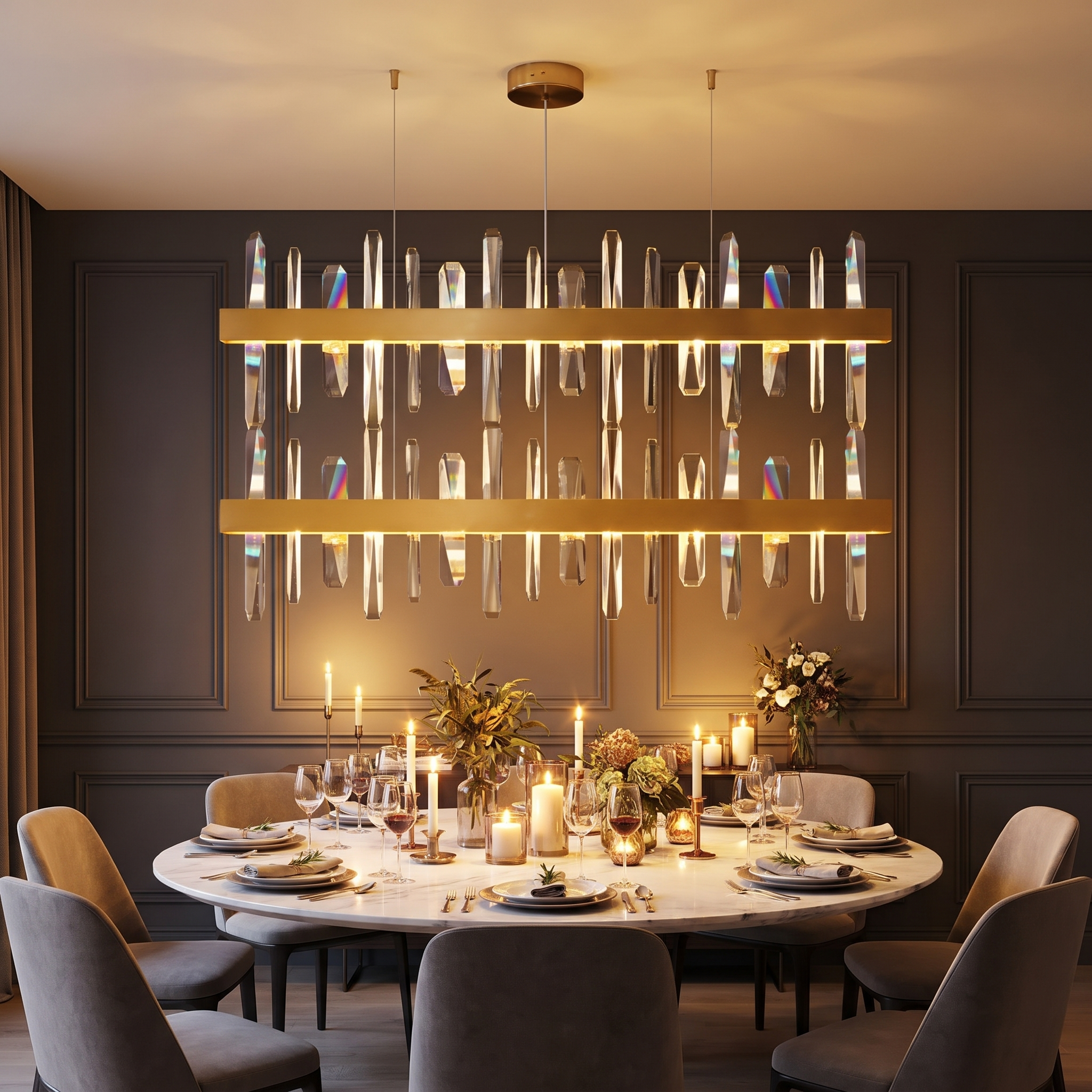
Two measurements govern dining room chandelier selection: diameter relative to the table, and hanging height above it.
Diameter: The chandelier should be 12 inches narrower than the table on each side. For a 48-inch (4 ft) round table: 24–30 inch diameter fixture. For a 72-inch (6 ft) rectangular table: 48–54 inches. For a 36-inch (3 ft) table: 18–24 inches.
Hanging height: Bottom of fixture should sit 30–34 inches above the table surface. This puts the light source at the right level to illuminate the table without blinding seated guests. For every foot of ceiling height above 8 ft, add 3 inches — so a 9 ft ceiling means 33–37 inches of clearance from table to fixture bottom.
Room sizing check: Add the room's length and width in feet. The sum in inches gives the right fixture diameter as a cross-check. A 12 × 14 ft dining room → 26-inch diameter is the baseline. If you're between two sizes, go larger — an undersized chandelier looks tentative in a dining room.
Best Styles for Dining Room Chandeliers
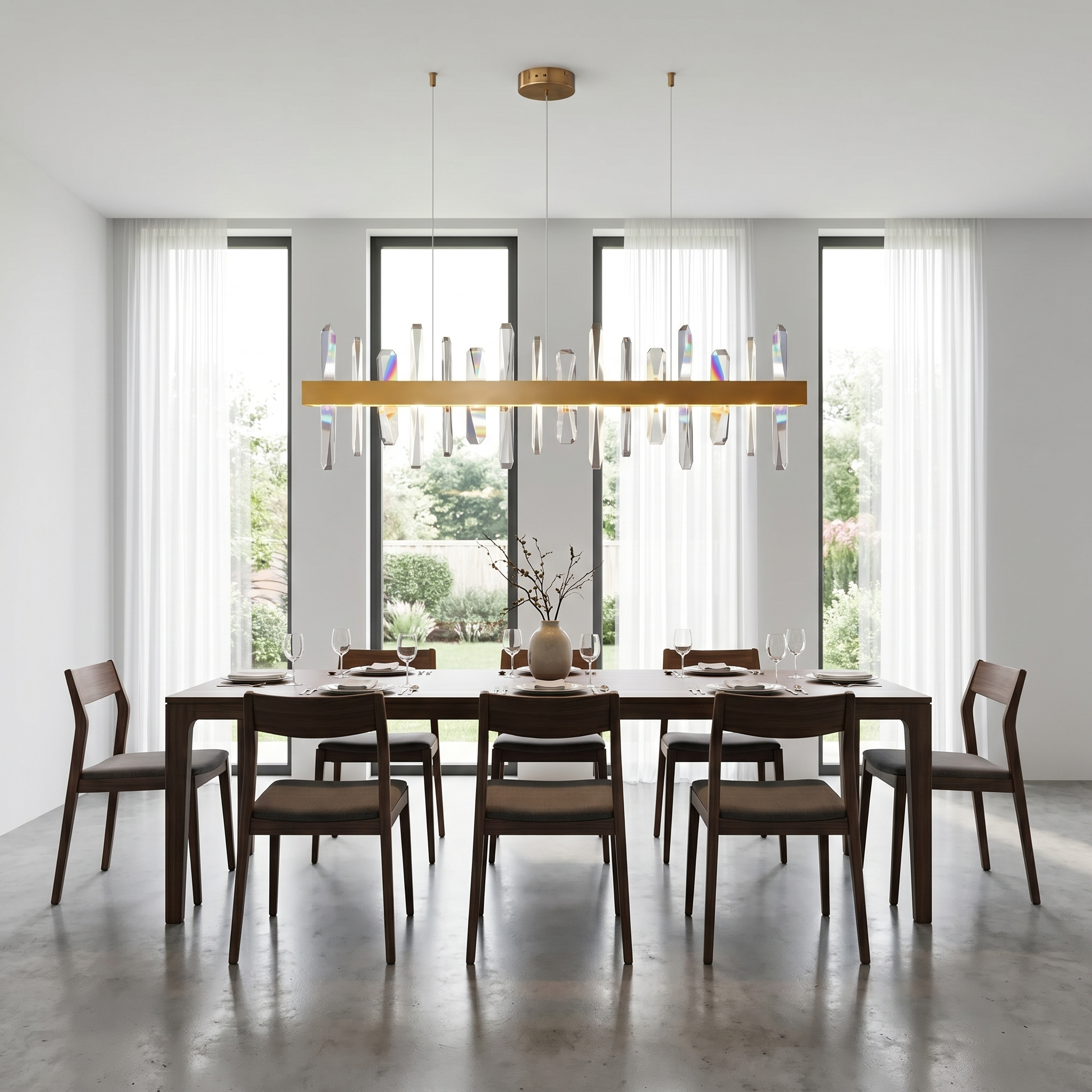
Dining rooms support a range of styles, but some designs consistently outperform others in this specific context.
Crystal Chandeliers
Crystal remains the benchmark for formal dining rooms. The reflective quality of crystal amplifies candlelight and creates sparkle that generic glass cannot match. Modern crystal designs — like the Aurora Luxe Modern Crystal LED Chandelier — deliver this effect with cleaner frames than traditional tier-on-tier designs. Gold-finished frames warm up cool crystal for a balanced result.
Linear and Rectangular Chandeliers
For rectangular tables over 60 inches, a linear chandelier often outperforms a round one. Linear fixtures run the length of the table, providing more even light distribution. The rule: linear fixture length should be 2/3 the table length. For a 72-inch table, a 48-inch linear fixture works well.
Ring and Halo Chandeliers
Single or double rings in brushed gold or matte black work in contemporary and transitional dining rooms. They're visually lighter than crystal designs and work better in open-plan spaces where the dining area transitions to a kitchen or living room. The Aurorae Crystal Halo Chandelier threads the needle — ring frame with crystal accents, formal but not heavy.
Sculptural Statement Pieces
In casual dining rooms or open-plan spaces, sculptural chandeliers — abstract forms, cluster designs, oversized pendants — make a stronger visual impression than formal crystal. Best paired with a casual table style and relaxed seating.
Dimmability: The Most Important Feature You Might Miss
Every dining room chandelier should be on a dimmer circuit. This is not optional. The difference between 100% brightness (practical for homework and eating) and 20–30% brightness (romantic dinner, cocktail hour) is the difference between two entirely different rooms.
For LED chandeliers, use a TRIAC-style LED dimmer — not an old-style incandescent dimmer. Most LED dimmer switches are clearly labeled. Verify the switch is compatible with your fixture's driver before installing. If you're adding a chandelier to a room without a dimmer, budget $20–40 for a compatible replacement switch.
Light Color Temperature for Dining
2700K–3000K is the dining room standard. This range produces warm white light similar to incandescent, which is flattering to food and to people. Avoid anything over 3500K — cooler white light looks clinical and makes food appear less appealing.
For candle-style chandeliers with visible flame-tip bulbs, look for 2200K–2400K LED candelabra bulbs, which closely mimic the warm glow of real candles. These are available in standard E12 and E14 candelabra bases.
Above-Table or Room-Center Placement?
Always position a dining chandelier centered over the table, not over the geometric center of the room. These are often the same, but in rooms where the table is pushed toward one wall or placed off-center, the chandelier should track the table.
Exception: if the dining area is part of an open-plan space with no defined boundary, centering over the table is even more important — it visually defines the dining zone and makes the table feel deliberate rather than floating in the room.
What to Know About Wiring and Installation
Dining room chandelier installation is usually straightforward if there's already a ceiling outlet centered over the table. The main considerations:
- Junction box weight rating: Standard boxes hold 35 lbs. Most chandeliers weigh 10–50 lbs. For fixtures over 35 lbs, install a fan-rated box or structural brace. Check the product weight spec before ordering.
- Chain vs. rod: Chain is adjustable and works for any ceiling height. Rod mounts are cleaner-looking but fixed-length — verify the rod length puts the fixture at the right height before installing.
- Sloped ceilings: Require a swivel canopy, which is an accessory for most chandeliers. Check whether it's included or sold separately if your ceiling has a slope.
Top Dining Room Chandeliers at Hausgem
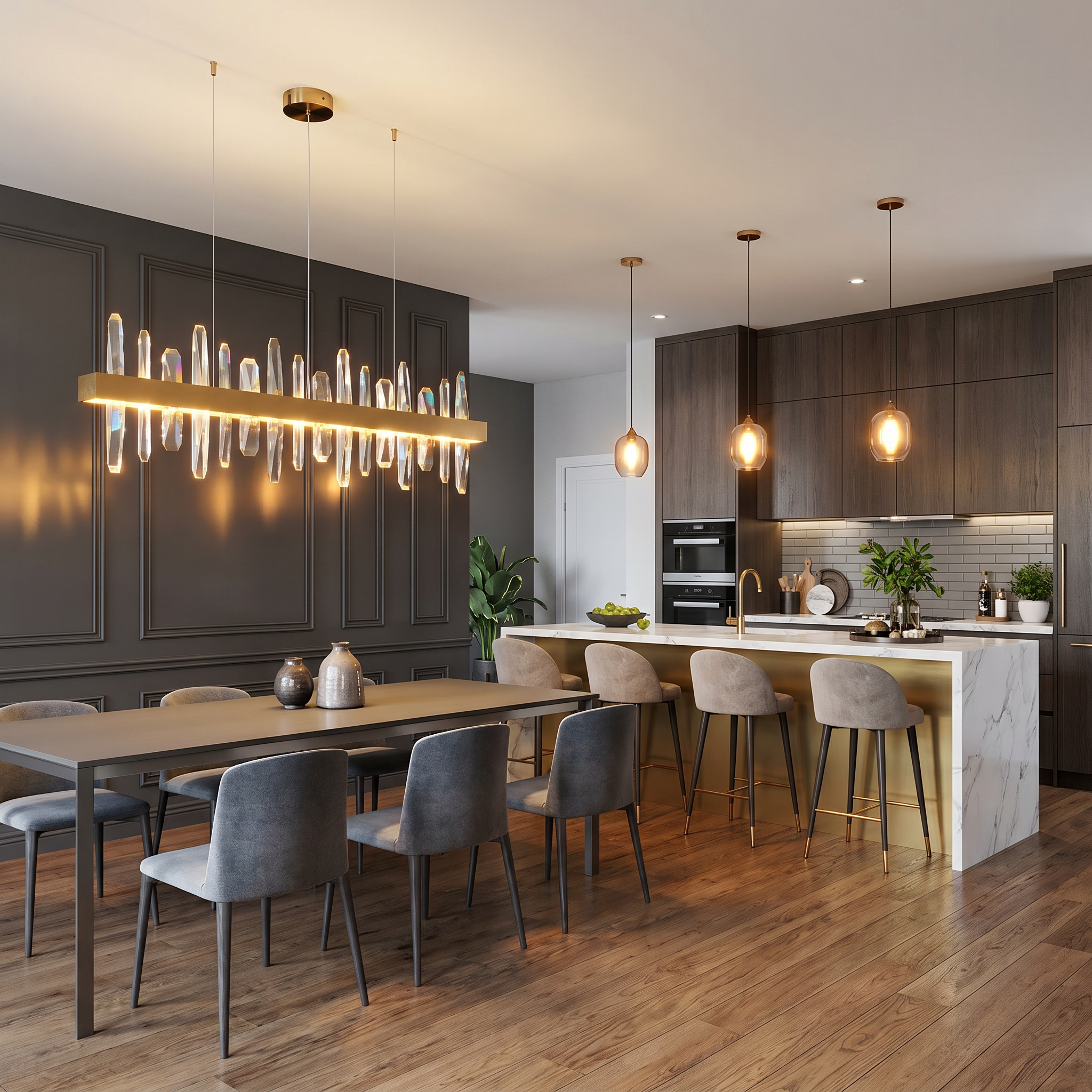
These specific fixtures consistently work well in dining rooms across different table sizes and room styles:
- Aurora Luxe Modern Crystal LED Chandelier — Gold finish, LED-integrated crystal design, warm 3000K light, fully dimmable. Best for 4–6 person tables.
- Aurorae Crystal Halo Chandelier — Gold ring frame with crystal drops, works over round and square tables. Formal but contemporary.
- Crystal Gem Luxury Chandelier — Clear crystal and gold, more traditional form. Best for formal dining rooms with 8+ person tables.
- Cloud Pendant Chandelier — Sculptural option for casual dining areas and open-plan spaces. Not suited for formal dining rooms but a standout in contemporary homes.
- Cassiopeia Crystal Halo Chandelier — Modern crystal design with clean ring structure. 30-inch diameter suits most 4–6 seat tables.
FAQ: Chandeliers for Dining Rooms
How high should a chandelier hang above a dining table?
The bottom of the chandelier should be 30–34 inches above the table surface in standard 8-foot rooms. For higher ceilings, add 3 inches per additional foot of ceiling height. At this height, light falls on the table and food without blinding seated guests looking across the table. See our complete chandelier hanging height guide for the full ceiling-adjusted formula and visual examples.
What size chandelier do I need for a 60-inch round table?
For a 60-inch (5 ft) round dining table, aim for a chandelier with a 36–42 inch diameter. The standard rule is to keep the fixture 12 inches smaller in diameter than the table on each side, and 12 inches inset from the table's edge. Slightly larger is better than smaller in most dining rooms.
Can I use a chandelier with a sloped ceiling?
Yes, with a swivel canopy mount. Most chandeliers can be adapted for sloped ceilings with this accessory (sometimes included, sometimes sold separately). For very steep slopes over 45°, check whether the manufacturer supports it — some designs become unbalanced on steep angles.
How many lumens does a dining room chandelier need?
For a 10×12 ft dining room (120 sq ft), aim for 1,200–2,400 lumens of general ambient light from the chandelier. For brighter task lighting during meals, target the upper end of that range and use a dimmer to adjust for mood. Product listings should specify total lumen output for LED chandeliers.
Should I get a crystal or glass chandelier for my dining room?
Crystal produces more sparkle and light dispersion than glass due to its higher refractive index. Glass is generally lower cost and more casual. For formal dining rooms, crystal is worth the investment. For casual or open-plan dining areas, a glass or non-crystal modern design may suit the space better.
Do I need an electrician to install a dining room chandelier?
If you're swapping a chandelier for an existing ceiling fixture, it's a manageable DIY project for someone comfortable with basic wiring (always turn off the breaker first). If you're adding a new ceiling outlet, extending wiring, or the fixture is heavy and needs a new junction box, hiring an electrician is the safer choice. Installation typically costs $150–$350 depending on complexity.
Want to see more options for your table? See the complete chandelier collection and sort by size, finish, and price.
Wondering which online retailers carry the best chandelier selections? Our where to buy chandeliers online 2026 guide ranks the top 8 stores by price, selection, and delivery.